




When it comes to sectors like IIoT, autonomous navigation, and high-precision surveying, positioning performance largely depends on proper RF design in the front end. At the same time, hardware manufacturers and procurement specialists tend to use the terms “GPS antenna” and “GNSS antenna” as synonyms while buying RF components. Despite being satellite navigation receivers, these types of antennas differ significantly in frequency bands, channels, and ability to deal with environmental signal interference. Thus, it is important to be aware of these differences while designing RF front ends.

1. Basic Concepts: GPS and GNSS Antennas Overview
To distinguish the differences in operation, it is necessary to understand their interaction with the architecture of the satellite constellation:
GPS Antenna
This type of antenna is designed specifically for receiving signals from the United States Global Positioning System. The standard single-frequency GPS antenna receives signals on the L1 band with a center frequency of 1575.42 MHz and a passband bandwidth ranging from 2 MHz to 10 MHz. Its architecture is simple and cheap enough for basic tracking devices with a margin of error of 3 to 5 meters.
GNSS Antenna
GNSS is the abbreviation for Global Navigation Satellite System, which encompasses an umbrella of global constellations. The GNSS Antenna is designed with wideband or multi-band resonant technology that can handle signals from GPS, China’s Beidou, Russia’s GLONASS, and Galileo constellations simultaneously. With enhanced bandwidth adaptation from 1164 MHz to 1610 MHz, the GNSS Antenna also provides faster lock time and stable phase centers.
2. Key Differences Between GPS and GNSS Antenna
To determine the exact differences between these two components in terms of hardware performance, consider the table below:
| Technical Parameter | Standard GPS Antenna | Multi-Constellation GNSS Antenna |
| Supported Constellations | GPS Only (USA) | GPS + BDS + GLONASS + Galileo + QZSS |
| Operating Frequency Bands | L1 Band (1575.42 MHz) | L1/L2/L5, B1/B2/B3, E1/E5a/E5b/E6, L1/L2/L3 |
| Total LNA Gain | 28 dBi to 30 dBi | 32 dBi to 40 dBi (High-linearity low-noise) |
| Axial Ratio | Less than 3 dB (At center frequency) | Less than 1.5 dB (Wide-angle across passband) |
| Voltage Standing Wave Ratio (VSWR) | Less than or equal to 2.0 | Less than or equal to 1.5 |
| Positioning Accuracy | 3.0 m to 5.0 m (RMS) | 1.0 cm to 2.0 cm (With RTK / PPP algorithms) |
Signal Redundancy and Lock Stability Under Obstruction
In operation in urban canyons, through thick tree cover, or near high-voltage power lines, the single-frequency GPS antenna suffers from multipath reflections that cause position shifts or total loss of signal lock. The GNSS Antenna, however, operates using the multi-constellation redundancy method by tracking 20 or more satellites in the sky.
Phase Center Stability and Polarization Tuning
High-quality phase center stability and correct Right-Hand Circular Polarization (RHCP) profile are critical in precision navigation. Multi-feed network design and choke ring ground plane allow the GNSS Antenna to reduce ground reflections and maintain phase center offset (PCO) within sub-millimeter tolerances.
3. How to Choose the Right Antenna for Your Application
Choosing between the conventional GPS antenna and GNSS Antenna depends on various aspects such as the physical environment and the materials of the enclosure, accuracy requirements, and budgetary constraints. Here are some merits of each antenna type based on different usage scenarios:
Fleet Tracking and Commercial Vehicle Telematics
- Conventional GPS Antenna Option: The conventional single-band GPS antenna will be best suited for simple fleet tracking applications, portable OBD dongles, and asset tracking tags where location accuracy of 3 to 5 meters is adequate. For commercial vehicle telematics applications where you need both location tracking and cellular communication features, you can use the dual-purpose antenna option. RF manufacturers such as FEI SHENG have come up with the GPS + LTE Combo Cabinet Antenna, which is the combination of a dependable GPS antenna and an efficient cellular LTE module into one package. This will keep the bill of materials cost low while ensuring low power consumption of circuits.
- Multi-system GNSS Antenna Option: In case your fleet vehicles travel through highly dense urban environments with tall buildings and even through tunnels, choosing the multi-system GNSS antenna offers you additional security from the aspect of multiple satellite constellations (GPS, BDS, GLONASS).
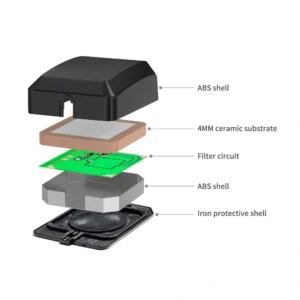
Precision Surveying, Agricultural Automation, and Drones
- Standard GPS Antenna: Single-frequency GPS antennas will do for entry-level agricultural tracking or flight logging without the need for sub-meter or centimeter accuracy.
- GNSS Antenna Option:RTK-based applications demand a full-band (L1/L2/L5, B1/B2/B3) GNSS Antenna. Single-band GPS antennas can only provide measurements from one frequency band, which is insufficient for ionosphere compensation; thus, a GNSS antenna is essential for the sub-centimeter-level accuracy required in land surveying and autonomous farming.
Industrial Cabinets, Smart Grids, and Wireless Control
- Standard GPS Antenna: In static industrial monitoring, smart metering, or RTUs where the device is static in location and does not require anything more than basic timestamping or periodic location reporting, a rugged GPS antenna is a reliable and cost-effective solution for your RF connection.
- Wideband GNSS Antenna: In case of a challenging industrial environment where there is interference from electromagnetic noise or where control cabinet enclosures are made of metal and need external mounting, a wideband GNSS antenna or high-performance external antenna is needed for optimal reception. An example of such an antenna for use in industrial control enclosures and outdoor cabinets, which require external wireless connectivity, would be the FEI SHENG 2.4G External Antenna Cabinet Antenna. This device has a rugged ABS enclosure and IP67 ingress protection.

Autonomous Driving and Timing Infrastructure
- Standard GPS Antenna Option: Auxiliary positioning of vehicles or ordinary station timing where microsecond timing is not required can be done using dedicated single-system GPS antennas which are cheap and easy-to-use.
- GNSS Antenna Option: Autonomous driving solutions and critical base stations of telecommunication infrastructure require synchronization at the microsecond level and high refresh rates (10 Hz to 20 Hz). High-gain active GNSS Antenna with integrated Low-Noise Amplifiers (LNAs) locks 20 to 30+ visible satellites at the same time, providing continuous signal lock and ultralow noise figures (below 1.5 dB) in any weather conditions.
4. Conclusion
In summary, selecting between a conventional single-frequency GPS Antenna or a multi-constellation GNSS Antenna solely depends on your project’s unique combination of budget, environment, and required accuracy. A conventional GPS antenna remains the best choice to go for an affordable, power-efficient, and reliable telematics solution for conventional fleet tracking, conventional asset tracking, and less stringent situations that require meter-level accuracy. On the other hand, a multi-constellation GNSS antenna becomes essential due to its capability of offering multi-system redundancy, wideband bandwidth, and interference-resistant features suitable for RTK surveying, autonomous driving, and heavy industry IOT. Using the right Antenna will get rid of the weak point of the radio-frequency chain in your system.
5. FAQ
Q1: Can I attach a simple GPS antenna to a multi-constellation GNSS module?
Yes, the hardware will connect and receive GPS signals; however, the receiver will be limited to single-constellation GPS operation. The bandpass filter of a simple GPS antenna reduces other frequency bands, excluding the satellites of the BDS or GLONASS systems.
Q2: Why are high-precision GNSS Antenna units larger than the standard GPS patches?
The higher-precision GNSS Antennas are equipped with complicated multi-feed arrays, 3D helical components, or choke ring structures underneath. These physical properties are needed in order to cancel the reflected multipath signals and to keep the constant phase center in wide frequency bands.
Q3: How can the antenna polarization affect the quality of the signal?
The satellite signals are transmitted using Right-Hand Circular Polarization (RHCP). The specific GNSS Antenna is designed to have matching RHCP polarization with a high axial ratio efficiency. A non-matching or linear antenna would result in at least 3 dB loss and unstable signal lock.
Q4: How do active and passive GNSS antennas differ?
The active GNSS Antenna includes low-noise amplifiers inside and needs DC power on the coaxial cable for long-trace loss compensation. The passive GNSS Antenna supplies the pure RF energy to the receiver without extra amplification and is useful for battery-operated devices with short traces.
Q5: What is the impact of nearby metal structures on antenna radiation patterns?
The proximity of metal structures to antennas can provide directional gain and help prevent multipath reflections from the ground. But if the metal structures are uncalibrated and close to or adjacent to the radiating element, they will lead to impedance mismatch, high VSWR, and a distorted radiation pattern.
Feel free to reach out to our technical team for GNSS Antenna selection, RF Impedance Matching, or ODM/OEM Antenna design!