




The Core Secrets of FPC Flexible Antennas Dominating the Market as Mainstream Communication Components
Against the industry backdrop of full-scale 5G popularization, explosive growth of IoT devices, and the prevailing trend of thinner and lighter smart terminals, competition in the wireless communication antenna industry has become increasingly fierce. Ceramic antennas, PCB onboard antennas, spring antennas, and metal shrapnel antennas each occupy a certain market share. However, FPC flexible antennas have achieved a strong turnaround, capturing over 70% of the consumer electronics and IoT antenna market and ranking first in global sales of core communication accessories. Its widespread popularity is no coincidence, but an inevitable result of accurately adapting to industry pain points while balancing performance, structural design, mass production, and cost advantages.
Superior Space Adaptability
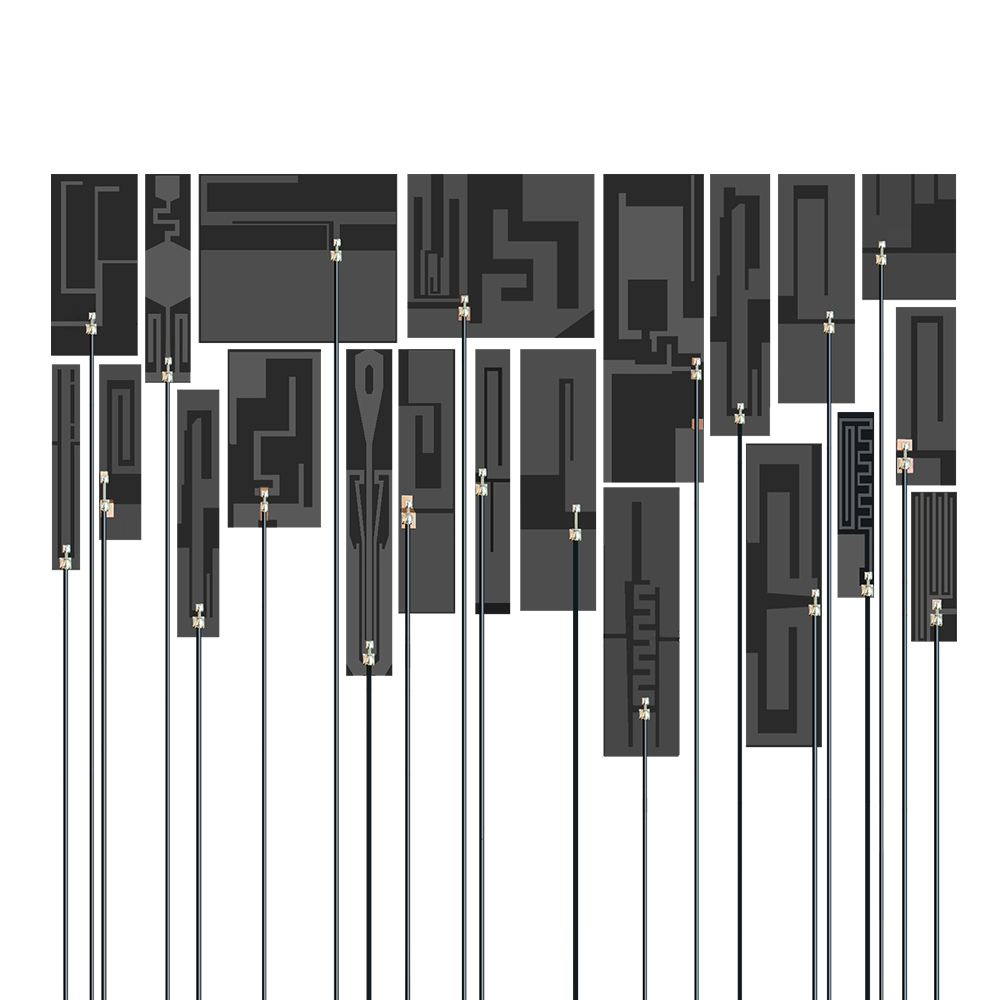
Superior space adaptability is the core advantage that enables FPC flexible antennas to outperform traditional antennas. The iteration of current smart hardware centers on thinning, miniaturization, profiling, and integration, which exposes the inherent drawbacks of traditional rigid antennas. PCB onboard antennas and ceramic antennas feature fixed shapes and can only be installed flat, making them incompatible with curved and narrow-gap device structures; spring antennas require reserved vertical space, severely squeezing the internal structural space of equipment. In contrast, FPC antennas are inherently lightweight and flexible, with a ultra-thin thickness of only 0.1 to 0.2 millimeters. They can be freely bent, curled, and cut into customized shapes, and can be mounted closely on device side walls, shell curved surfaces, battery gaps and other narrow areas. They effectively avoid signal interference from mainboard chips and wiring harnesses, saving 30% to 50% of internal space compared with traditional antennas, and perfectly meet the lightweight design requirements of TWS earphones, smart bracelets, ultra-thin smart home devices, vehicle-mounted terminals and other portable hardware products.
Stable High-Frequency Communication Performance
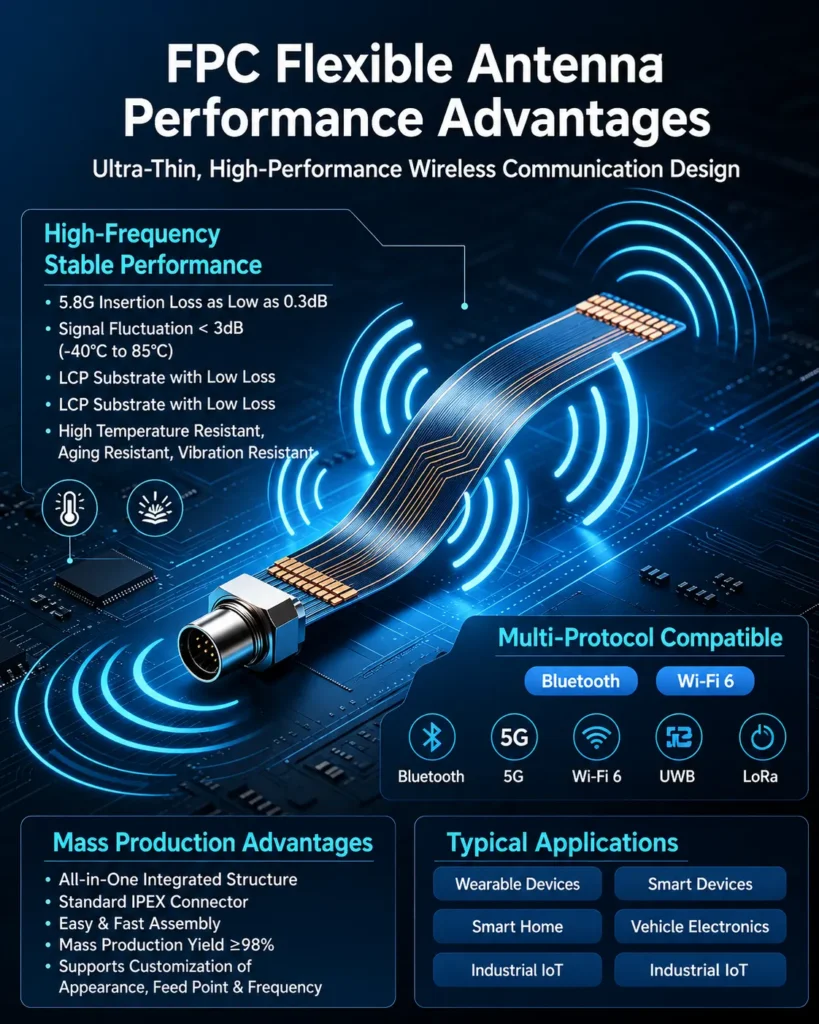
Breaking the misconception that “flexible materials deliver poor signal performance”, FPC flexible antennas boast robust and professional communication capabilities. Adopting high-end low-loss LCP and PI substrates, they deliver far superior high-frequency performance compared with most traditional antennas, with an ultra-low signal loss of 0.3dB at the 5.8G high-frequency band, ensuring efficient and stable signal transmission. Additionally, they support full-temperature operation ranging from -40℃ to 85℃, with signal fluctuation less than 3dB under extreme high and low temperature conditions. Featuring high temperature resistance, aging resistance and vibration resistance, they are fully applicable to harsh application scenarios such as vehicle-mounted systems and industrial IoT. Furthermore, FPC antennas support full compatibility with multiple communication protocols including Bluetooth, WiFi 6, 4G, 5G, UWB and LoRa. A single FPC antenna can realize multi-mode signal transceiving, eliminating the redundant structural design of stacking multiple traditional antennas. Meanwhile, flexible installation positioning helps reduce clutter interference from mainboard power supplies and high-frequency components, greatly stabilizing the network connection of smart devices.
Mass Production and Flexible Customization
Excellent mass production adaptability and flexible customization capabilities are key drivers of its large-scale popularization. Traditional antennas have prominent production drawbacks: spring antennas are prone to deformation and cold solder joints, ceramic antennas are fragile and easy to damage during assembly and transportation, and PCB onboard antennas require long-cycle and high-cost mainboard modifications for iteration, seriously restricting production efficiency and yield rate. In comparison, FPC flexible antennas adopt an integrated structure with excellent drop resistance and bending resistance, resulting in extremely low loss during transportation and assembly. Equipped with standardized IPEX connectors, they support one-click automated assembly on production lines, with a stable mass production yield rate of over 98%, perfectly suitable for large-scale industrial manufacturing. Moreover, FPC antennas support personalized fine-tuning of shape, length, feed points and frequency bands without modifying the device mainboard, enabling rapid sample production and iteration. They well balance standardized mass production and differentiated customized demands across various industries.
Wide Application Across Smart Hardware
At present, FPC flexible antennas have achieved full-scene penetration and covered the entire communication track including consumer electronics, smart home, vehicle electronics and industrial IoT. They can perfectly adapt to diverse devices, ranging from ultra-thin portable wearable devices and 24-hour operating sensor gateways to vehicle-mounted and industrial control terminals with harsh working conditions. The core competitiveness of FPC flexible antennas lies in breaking away from single parameter involution. It comprehensively solves four major engineering pain points in hardware development: structural space limitations, radio frequency communication instability, mass production efficiency bottlenecks, and market iteration customization demands, making it the optimal antenna solution for the new generation of smart hardware.